Data Exchange and Data Transmission
Data Exchange and Data Transmission
Data exchange is the term used to cover all methods of passing data between digital devices and peripheral devices over a network.
The internet is one network where data is exchanged but data exchange takes place on all types of networks.
This can be classified by the direction of data exchanges; simplex, duplex and half duplex. It can also be classifie by how much data can transfer simultaneously: serial and parallel transmission.
Types of Communication Channels
- Simplex – Data is transmitted in one direction only.
- Half Duplex – Data is transmitted in both directions but only ever in one direction at a time.
- Duplex – Data is transmitted in both directions simultaneously.
- Point-to-point – Communication between two endpoint 'nodes'(e.g. a telephone connection where only the two phones can hear each other, or a network switch).
- Multi-drop – Multiple devices/or components connected to the same communication network/bus and listening for data that is specifically for them.
| Basis for comparison | Simplex | Half Duplex | Full Duplex |
|---|---|---|---|
| Direction of Communication | One direction only | Both directions but only ever in one direction at a time | Both directions simultaneously |
| Send / Receive | Send | Send and receive at one time | Send and receive data simultaneously |
| Example | TV Remote Controls | Walkie-talkie | Phone call |
Types of Data Transmission
Serial Transmission
 In serial transmission, bits are transmitted one at a time over a single wire/channel. This reduces the cost of the cable but gives a slower rate of data transfer.
Bytes must be disassembled into individual bit and then reassembled on receipt (more complicated).
info
Serial transmission can be used to connect mice and keyboards to computers but has mostly been replaced by USB and wireless connections.
Parallel Transmission
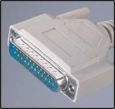
In parallel transmission, a number of 8 bits of data are transmitted simultaneously (at the same time) over an equal of wires/channels. This allows the bits in a whole byte of information together.
This has a shorter range than serial. Parallel transmission used to be popular for connecting printers but has mostly replaced been due to its cost and limited range.
Now the methods that we use to connect printers is via wireless.
Universal Serial Bus (USB)
 USB is a serial transmission method that was introduced to make many of the connections to a computer the same.
This provides a consistent method to connect peripherals to a digital device.
USB is a higher-speed serial connection that supports both low speed device (e.g. mice, keyboards, pen drives) and higher speed devices (e.g. digital cameras).
Voice over Internet Protocol (VoIP)

VoIP is a group of internet protocols that provide an method for sending voice and multimedia communication over the internet rather than by public telephone networks.
VoIP provides real time communication and is growing in popularity.
Any computer system that has a microphone (input) and speaker or headphone (output) and a broadband connection can be used to transmit and receive voice communication using VoIP.
info
Using a webacam this will allow multimedia. When many users have these facilities, web meetings and conferencing can be set up.
Skype, facebook, discord, etc... use the VoIP system. The software required to run a VoIP system consists mainly of an coder/decoder program (codec).
This program is used to digitise an analogue voice signal then compress it and split it into internet packets for transmission.
It then performs the reverse at the receiving end to produce audio output.
Wireless
A wireless network is any network (including the internet) using computers or other devices in which the connections do not use cables of any kind.
Wireless communication usually uses radio waves but infrared communication can also be used. All devices using the network need to have a wireless network interface card through which they gain access to the network. The card is used to transmit data across the network and to receive incoming data from the network.
The network will contain routers to forward data packets.